Case Report
Bilateral Mandibular Simple Bone Cysts: An Unusual Case Report
1. Abstract 1.1. Background Simple bone cysts are intraosseous cavities that are surrounded by bony walls, and they are either empty or contain liquid and/ or connective tissue.
Bilateral Mandibular Simple Bone Cysts: An Unusual Case Report Read More »
A ‘Novel Breakthrough’ For Gastric Bands
1. Abstract 1.1. Introduction We share a rare case of 39-year-old male with a percutaneous erosion of gastric band tubing. Till today, there is no comparable case in the literature.
A ‘Novel Breakthrough’ For Gastric Bands Read More »
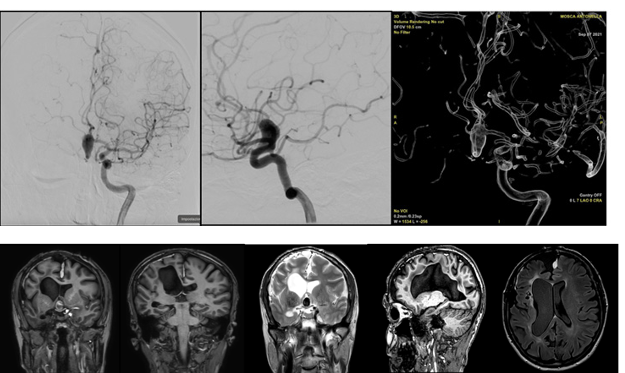
Linear Scleroderma “En Coup de Sabre” with Neurological Manifestations and Neurovascular Abnormalities: A Case Report
1. Abstract Localized scleroderma (LoS) is distinct from systemic sclerosis due to the lack of visceral involvement: among its subtypes, linear scleroderma “en coup de sabre” (LScs) has been associated
Relevance of Expanded Newborn Screening in Maple Syrup Urine Disease: A Case Report
1.1. Background Maple Syrup Urine Disease (MSUD) is a rare inherited metabolic disorder that, if not diagnosed and treated promptly, can lead to severe complications in newborns, including encephalopathy, irreversible neurological damage, and even death.
Relevance of Expanded Newborn Screening in Maple Syrup Urine Disease: A Case Report Read More »
Exploring Innovative Treatment Options for Lumbar Extradural Cysts: A Case Report
1. Abstract Spinal synovial cysts, rare fluid-filled sacs associated with facet joints, are typically linked to degenerative changes affecting spinal stability. These cysts, predominantly found at the L4/5 facet joint, can cause back pain, radiculopathy.
Exploring Innovative Treatment Options for Lumbar Extradural Cysts: A Case Report Read More »
Variations In the Branching Pattern of Aortic Arch and Its Clinical Correlation A Computed Tomographic Angiographic Study
1. Abstract 1.1. Background Variations in branching pattern of aortic arch (AA) can occur, due to it’s complex embryological development. These variations are quite common, and typically asymptomatic; but can sometimes cause dyspnea, dysphagia, intermittent claudication, and/or confusion in interpretation of radiological scans. Methods: The types and incidence of aortic arch variations in 105 patients
